The Svaneti journal
Mestia to Ushguli: chacha, storms and a barefoot climb

Mestia–Ushguli · Svaneti · Georgia · Summer · 7 min read
Svaneti is more than a destination. It can leave you tired, humbled and strangely renewed. This is my story of walking from Mestia towards Ushguli: familiar faces far from home, mountain weather, glacier water and evenings that could never fit into an itinerary.
By Tilen Fajon · English adaptation of the original Lifetrek account.
This is a story that life writes for you. Life, and Georgia. Georgia rarely disappoints if your heart is in the right place and your liver is ready for action. Meeting “our” Ana in the middle of the Caucasus, discovering her husband Mate’s Svan roots, and feeling that the mountains have chewed you up and sent you home a better person: some stories almost write themselves.
Elbrus from the window, Mestia on the ground
It began on the flight to Kutaisi. Most people were sleeping or reading. I was pressed against the window. And there it was: Elbrus, the king of the Caucasus. It rose above the sea of clouds and surrounding summits like a white, uncompromising monarch. More than 5,600 metres of ice and respect. Looking at it from the air, I understood that the landscape below was no place for complacency. It was wild country, and that was exactly where I was heading. What I had imagined as a walk in Georgia was about to become a lesson in humility.
Mestia, the heart of Svaneti. On my previous visit, everything had worn a thick coat of snow. I had skied those slopes, drunk mulled wine and wondered at the defensive towers reaching into the sky like stone fingers. Now everything was green. Yet something felt the same: that curious sense of coming home.
And who should be standing outside the guesthouse? Ana. Hearing your own language in the middle of the Caucasus and hugging someone you know is a feeling that is hard to price. “This time I’ll be your trip leader, but Lasha will be the boss,” she laughed. Lasha was Svan through and through: solid, with a smile that seemed to hold the history of his mountain people, and a handshake that almost crushed my bones. He would be taking us through the mountains. I could hardly have asked for better company.
Electronic detox: goodbye, outside world
Svaneti seemed to give me one rule: put the phone away. Where there was no signal, the decision was made for me. Where there was, I gradually stopped needing it. That was my electronic detox. On the first day, the hand still twitches towards the pocket. What if someone needs something urgently? What if I miss an important email? By the second day, the date begins to lose its significance. By the third, I realise that I feel free. Svaneti makes you look at the world instead of a screen.
The first day of walking was a warm-up: flower-filled meadows, sunshine and mountain air that felt almost painfully clean. That evening we stopped in Zhabeshi. Lasha pulled a plastic bottle from his pack. It did not contain water. It contained chacha, Georgian spirit with a considerable bite. “To Tetnuldi,” he said, raising his glass towards the mountain above the valley. Tetnuldi’s white pyramid shone in the moonlight. We sat outside wrapped in blankets, sipping that fire and talking about life. And the stars. Honestly, you could almost imagine picking them like apples.
A storm at Adishi
The next day brought Adishi, a village that seemed to have been misplaced somewhere in the Middle Ages. Stone houses, mud and cows in the lane. Then the light disappeared. The sky closed in within minutes. A mountain storm is no small thing, and this one caught us just before the village. Thunder echoed between the canyon walls as though the mountains were coming apart. The rain did not fall; it lashed us. We ran for shelter in the first house, soaked through and laughing with relief.
Lasha simply shrugged. “That’s Svaneti. It gives you a fright, then dries you off all the better.” In that old kitchen, beside the wood-burning stove and the smell of kubdari, the local meat-filled bread, his words made perfect sense. It was difficult to imagine a more reassuring place to be.
Glacier water, horses and the Chkhunderi pass
The third day brought the river below Adishi Glacier. I stared at the water: grey, cloudy, rushing over the rocks, and apparently cold enough to freeze a smile off your face. Lasha looked at me and pointed towards the local horsemen. “Don’t be a hero. The water is strong and deceptive. We’re going across on horseback.” I admit that the idea of wading had crossed my mind. His expression ended that discussion. We paid the horsemen and climbed into the saddles. When an animal steps into that rushing water, picking its way between the rocks while you draw up your legs and hope it knows what it is doing, the experience is memorable. At least our feet stayed dry.
Something changed in me on the far bank. I looked up towards Chkhunderi pass, around 2,700 metres above sea level. A grassy slope curved towards the sky, scattered with stones and mud. “I’m going on barefoot,” I said, and began undoing my laces. I put my boots in the pack and placed my bare feet on Georgian earth. The first steps were cautious. The grass felt cool and soft, although sharp stones and cold mud lay between the pleasant patches.
But the feeling. Walking became a direct connection with the ground beneath me. I noticed every bump and every change in temperature. Other hikers, securely wrapped in their Gore-Tex boots, looked at me as though I were a slightly unhinged monk. I was absorbed in every step. When I finally stood at the pass, feet dirty, with the huge Adishi Glacier across the valley, I felt a freedom I still remember. No rubber between me and the world. That barefoot climb was my own spontaneous choice on that day, rather than a model for how anyone else should tackle the route.
Iprali: a waterfall and an evening nobody planned
The descent towards Iprali was long. My knees noticed. There was dust. Then Lasha winked: he knew a “shortcut”. We turned into the vegetation, and suddenly there was a roar. A hidden waterfall in the forest, the sort of place you can walk past without ever knowing it is there.
That evening, in an Iprali guesthouse, something happened that could never be neatly scheduled. Here, a guesthouse is simply a house where you sleep well, eat well and spend time with the people who live there. Dinner had filled the tables with khachapuri, aubergines with walnuts and salads. Afterwards someone put on music. The locals stood up and began to dance: proud and upright, the men seeming to float above the floor. You can arrange a journey. You cannot order a moment like that from a menu.
The sheepdog on the trail
On the final stretch towards Ushguli, the path had a steep drop on one side and a wall of rock on the other. Then, from around a corner, came a deep, bass-heavy bark. A Caucasian sheepdog. This was no ordinary dog; it looked like a bear with a tail. Its collar had outward-pointing spikes, protection against wolves. It stood in the path, as large as a calf, and assessed us.
Lasha moved forward calmly, holding his pole to keep some distance, and spoke firmly in Svan. The dog stopped, looked us over and apparently decided that we posed no threat to its sheep. Then it moved aside with almost insulting ease. My heart took another half-hour to return to its usual place.
Ushguli and its mountain Picasso
Ushguli. One of Europe’s highest inhabited communities, with towers everywhere you look. Among them was a house that seemed like the others, but held the work of an extraordinary artist: Pridon Nizharadze, often called the mountain Picasso. The rooms were full of paintings. Surrealism, disorder, colours, faces that seemed to shout and landscapes that breathed. His art felt like Svaneti itself: wild, difficult to understand at first glance, and full of depth.
The walk was over, but the adventure was not. Returning to Mestia in a Delica minivan was an experience of its own. The road hung above the valley. My attention alternated between the drop and the bends ahead. “Relax,” Lasha laughed. “They know every bump and corner.” Georgia has a talent for keeping a journey interesting right up to the end.
The last evening in Mestia
On our final evening, Lasha, Ana and I were joined by Mate, Ana’s husband. This time the drink was Georgian brandy rather than chacha: soft and velvety. We sat in a small local bar where the people around us were singing. Georgian polyphony. Three male voices intertwining in a harmony that raised the hairs on my arms. To me, it felt less like a performance than a prayer.
I was grateful. Grateful to have returned, to have seen these mountains without their snow but with their soul entirely intact. Svaneti takes your energy on the trail and gives something back that follows you home. Goodbye, Caucasus. We will meet again.
Another way to meet these mountains
This is the story of a particular journey, with the people, weather and choices that made it ours. To plan your own summer visit, explore our Georgia trekking programme for the current itinerary and arrangements. For a different perspective, read Srečo’s account of day hikes to Svaneti’s glaciers, with Mestia as a base.
Photographs from Svaneti

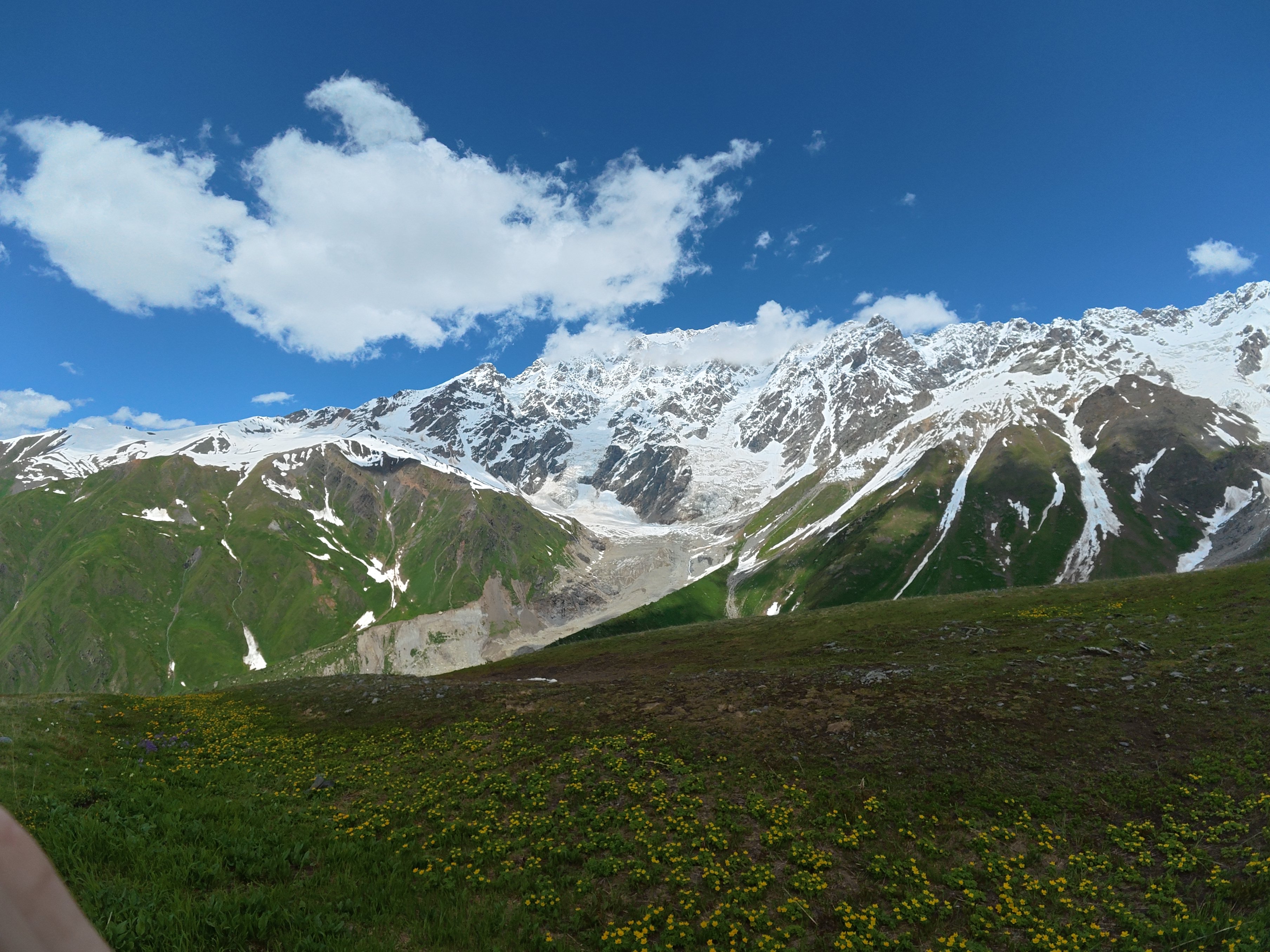
Photographs: Lifetrek archive.
Adapted from the original Slovenian article on Lifetrek.si. The author’s personal experience is retained; wording and a few factual details have been edited for the English edition.