The Svaneti journal
Svaneti’s glaciers: day hikes on the sunny side of the Caucasus

Mestia · Ushguli · Svaneti · Georgia · Summer · 9 min read
Flowering slopes and white glaciers. Day walks, a comfortable place to stay in town and the flavours of Georgian restaurants. Was that enough for a wonderful holiday? Irena and I decided to find out on the sunny side of the Caucasus.
By Srečo Rehberger · English adaptation of the original Lifetrek account.
Looking beyond the famous Mestia–Ushguli trek
The trek from Mestia to Ushguli is well known for good reason. Beautiful landscapes, villages with their unmistakable towers, rivers and streams, green alpine meadows full of flowers, and white summits rising above five thousand metres. These are things that no visitor can easily overlook. Yet I think many people walk past something else, perhaps without giving it much thought.
Glaciers. We talk a great deal about their importance to the mountain world and the planet. We know they are shrinking. But are we really interested in seeing them, getting close enough to appreciate their scale? Even when we happen to be nearby, do we properly notice them? These enormous masses of snow and ice, always moving although the movement is invisible to us, broken by crevasses and towers of ice.
The Caucasus has a remarkable glacial landscape, but it is changing. Satellite research covering the Greater Caucasus between 2000 and 2020 documents accelerating glacier area loss. Knowing that gives the views another significance. On this visit, what struck me was how much magnificent ice we could still see from walking routes and viewpoints, without turning every outing into a major expedition.
That is what Irena and I chose: to enjoy ourselves without unnecessary hardship, as a holiday ought to allow. We wanted to visit the highlights of the popular trek, add a few of our own and put the glaciers at the centre of the journey. They are among the most striking pieces in Svaneti’s mosaic of mountain landscapes. How could someone from the sunny side of the Alps fail to notice the sunny side of the Caucasus?
Our journey began in Mestia, sometimes called Georgia’s Chamonix, and would finish in Batumi, its supposed Las Vegas. I am not sure either comparison stands up to close examination, but both have found their way into conversation. This was my fourth visit in ten years. Mestia was changing quickly: growing, developing, filling with new life. After the long drive through less prosperous places, the sudden bustle of a mountain town at the end of the road was striking.
It was a contrast that both pleased and troubled me. I had felt something similar in Pucón in Chile, where I had been skiing less than a year earlier. A town whose tourism brought opportunities and a standard of living that stood apart from its surroundings. What tourism gives. And what it takes. In both places, mountain tourism played a large part. Chamonix, too, had once been a modest farming village. Then came the climbers, skiers, walkers and visitors.
Ushguli: the glacier below Shkhara
Our walk began near the Shkhara Glacier Restaurant. We followed the Enguri valley, passed Romi Lake and continued to an unnamed summit at around 3,150 metres. For us, it made an enjoyable day of roughly 800 metres of ascent. Shkhara remained in front of us throughout: Georgia’s highest mountain, rising above 5,200 metres. Its southern face is enormous. Ice pushes high into the wall and continues in separate bands across it. Meltwater from the glacier helps give the Enguri its force.
Ushguli, often introduced as one of Europe’s highest inhabited communities, has become a destination in its own right. On our visit, the road, places to eat and accommodation were a world away from the isolation described in older stories. It had not always been like that. Dede, the film by Ushguli-born director Mariam Khatchvani, offers a vivid picture of traditional life, the desire for change and the difficulties of reaching Mestia in winter. Watching such a story gives the towers and surrounding valleys a different meaning. Their beauty is inseparable from the lives lived beneath them.
Khalde: views towards Tetnuldi and Jangi-Tau
From Khalde, we walked through a beautiful valley above the river, then climbed past abandoned shepherds’ huts towards Chkhunderi pass and along the ridge to an unnamed summit at around 2,850 metres. Our ascent was roughly 700 metres. What a ridge for wandering. Views opened into both valleys, with glaciers filling the scene. The ice descending below Tetnuldi was particularly impressive. We could trace the river away from it through the green valley towards Adishi, another of Svaneti’s memorable villages.
Tetnuldi and Jangi-Tau stood in front of us, their immense walls making even the broad valley seem small. Khalde itself was quiet, but its history was anything but. The village is remembered for resistance to Russian imperial rule in the nineteenth century. Its ruined towers belong to that story. The people of Svaneti speak of Khalde with great respect, and the song Gaul-Gavkhe carries the memory of its resistance. In these mountains, a place can seem almost empty while still holding a powerful presence.
Koruldi and Chalaadi: two perspectives below Ushba
Chalaadi Glacier, also written Chalaati, gave us two quite different views: one from the valley below and another from high above it. Each outing had its own character. The lower approach took us through forest and then beside the river, along a relatively gentle path. Beyond the trees, the moraine, rushing water and broken ice revealed a landscape with tremendous energy. The river emerging from the glacier was a reminder that the apparent stillness of the ice is only part of the story.
Glacier fronts and moraines change, and falling ice and stones make close approaches hazardous. The views described here are memories of our visit, not instructions to continue beyond a warning sign or enter an ice cave. For a visit today, the marked route, any closures and local advice determine the appropriate viewpoint.
The high viewpoint was a different sort of day. The drive up towards the Koruldi Lakes, around 2,800 metres, demanded rather more of the driver than of us. From Mestia, it involved about 1,300 metres of elevation gain on a slow mountain road. The lakes were our starting point for a walk towards the ridge and Tskhazagar, at around 3,300 metres. The final stretch was steeper, with loose ground. Then came the view. Ushba, the queen of the Caucasus, stood before us in all her beauty and severity. Below, Chalaadi Glacier twisted down towards the valley. A mountain scene that needed no embellishment.
Zhabeshi: flowers, gorges and glacier rivers
Zhabeshi is one of the villages associated with the familiar trekking route. It also deserves attention for its traditional food. Behind it, two less frequently visited gorges lead towards the Tsaneri and Tviber glaciers. These were not straightforward trails. The paths disappeared in places, and steep grassy and wooded slopes dropped towards powerful rivers below.
We did not reach the glaciers. That was fine. The walk still rewarded us with wonderful colours and the sense of moving through a botanical garden. Flowers, butterflies and the constant roar of glacial water: a remarkable combination of contrasts. Sometimes a day is memorable because of what you notice along the way, rather than the point you had hoped to reach.
Mestia, once Seti: life between the walks
The centre of town is Seti Square, with benches, a playground and a distinctive fountain that attracts more than just human visitors. Nearby stands the bronze statue of Queen Tamar, the legendary ruler whose name occupies an almost sacred place in Georgian history. It is not a conventional royal portrait, and the horse in particular has prompted debate. Does it look rather like a pregnant cow? Perhaps the unusual form is meant to suggest the weight of power borne by a young queen who had to govern instead of living freely. Whatever the interpretation, the statue has become part of the town’s identity.
A few hundred metres away, the view from a bridge into a deep gorge surprises us. You do not expect such a drop in the middle of town. But Mestia’s defining feature, as throughout Svaneti, is the defensive tower. Families once took shelter with their animals, food and possessions inside those thick stone walls. Wooden ladders connected the levels, and the roof provided a view over the surroundings. The towers are beautiful to look at; remembering their purpose makes them more than a picturesque backdrop.
The old Margiani family house gives another impression of that earlier life. A hearth, tools, everyday objects and a large shared space for the household and its animals. There is an immediate sense of how warmth, work and survival shaped the building. The same tradition of tower houses is part of what makes Upper Svaneti’s World Heritage landscape, particularly Chazhashi in the Ushguli community, so remarkable.
And the food? Georgia has plenty of dishes that have become familiar far beyond its borders. Our own discovery was Svan yoghurt with a wonderfully natural, slightly lumpy texture. I was entirely ready to believe that the milk came from cows grazing above the nearby villages, with homemade cherry or raspberry topping completing the bowl. Sometimes the smallest things make a holiday feel properly good.
Batumi: a very different Georgia by the Black Sea
The drive from Mestia to Batumi took us from the heart of the Caucasus to the Black Sea in about six hours. We arrived with a substantial hole in the vehicle’s rear window. In a narrow gorge, a stone had broken away from the wall beside the road and struck the back of the vehicle, landing in the luggage area. Irena had been sitting less than half a metre away. It was a sobering moment in a journey full of beautiful views.
Before leaving Svaneti, we stopped on a bridge over the Enguri. What power in that river. Mate had shown me a narrow passage higher up, with the water forced between great walls of rock. Watching it rush through that gap made the relationship between the mountains, glaciers and rivers feel very real.
I had initially dismissed Batumi. But we went to look, and I had to admit that it had its own attractions. A mild coastal atmosphere, old and new architecture side by side, tall hotels, casinos, all sorts of diversions, a lake with canoeists and a long seafront promenade full of cyclists, scooters and skaters. After the mountains, it felt like an entirely different country.
Ali and Nino
Among Batumi’s sights, the moving figures of Ali and Nino stayed with me most. A man and a woman made from layered steel slowly approach, pass through one another and separate again. The sculpture suggests love that reaches beyond cultural and religious boundaries. For me, it became Batumi’s defining image. A quiet idea of connection in a city that seemed determined to offer every possible distraction.
Two ways to spend a summer in Svaneti
Irena and I chose day walks and a comfortable base. Other travellers prefer the continuity of moving from village to village. For that perspective, read Tilen’s Mestia to Ushguli trekking story. If you are considering a journey with us, our Georgia summer trekking programme sets out the current route and arrangements. The outings described in this account belong to our own visit; they are not a promise that every route or an extension to Batumi is included in the current programme.
Photographs from Svaneti
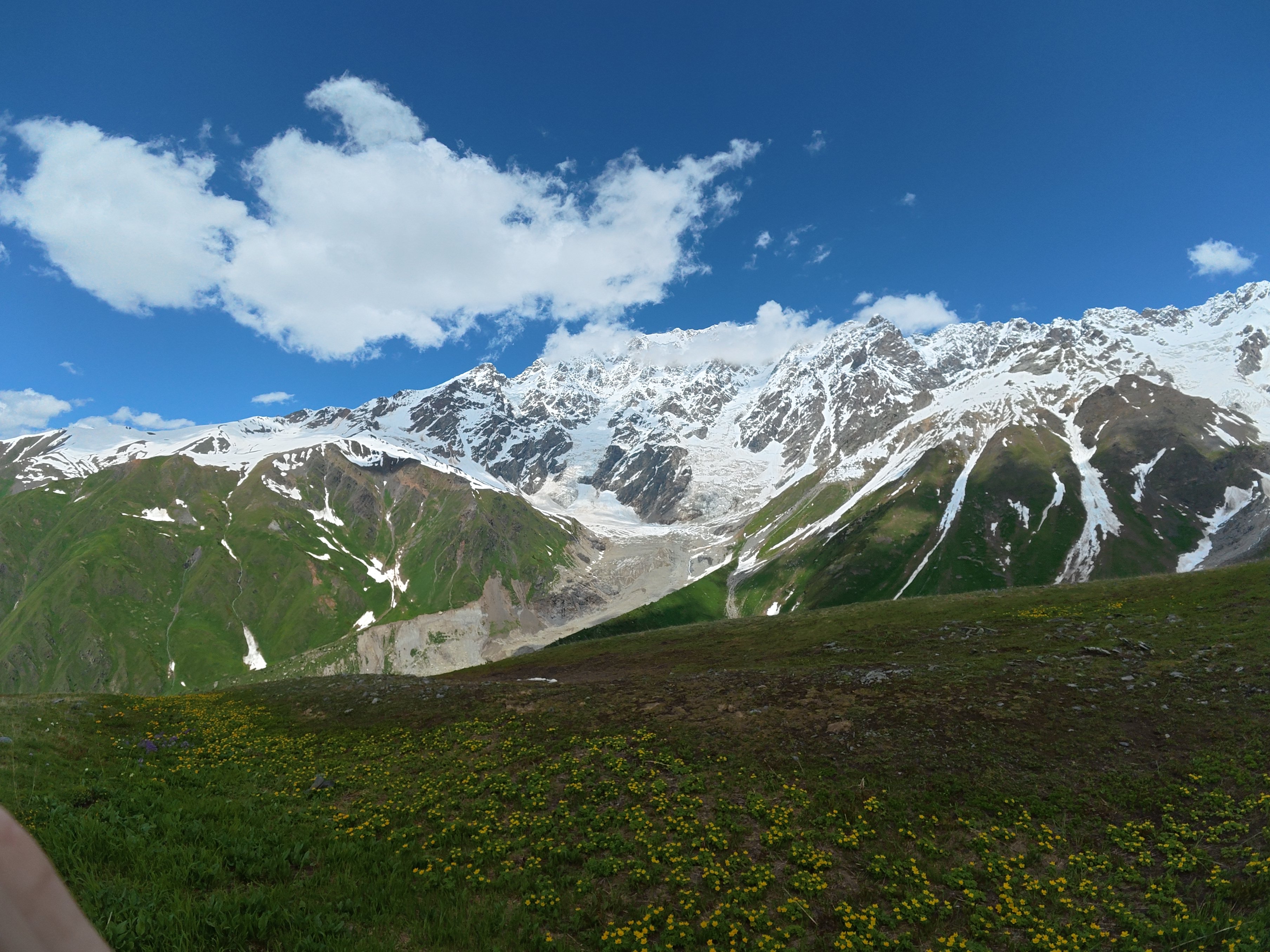


Photographs: Lifetrek archive.
Adapted from the original Slovenian article on Lifetrek.si. The author’s personal experience is retained; wording and a few factual details have been edited for the English edition.